

Table of Contents
- The Real Cost of Fast Fashion: What Your €20 Dress Isn't Telling You
- Benefits of Slow Fashion: Why Independent Boutiques Win on Quality
- How to Build a Sustainable Wardrobe Without Starting From Scratch
- Capsule Wardrobe Essentials: What to Buy From Independent Boutiques
- Value Per Wear: The Financial Case for Independent Boutiques
- How Independent Boutiques Support Local Economies and Ethical Manufacturing
- Spotting Greenwashing: How to Vet Small Brands Before You Buy
- Frequently Asked Questions
Last Updated: September 23, 2026
The Real Cost of Fast Fashion: What Your €20 Dress Isn't Telling You
That €20 dress costs more than €20. It costs the person who sewed it, the river that absorbed the dye runoff, and eventually, you, when the seams give out after three washes. Understanding why choose independent boutiques over fast fashion starts with seeing the full price tag, not just the one on the hanger. At Yelo Ribon, we are dedicated to offering stylish and wearable clothing for both everyday life and special occasions. The difference isn't budget. It's math.
Fast fashion works by chasing speed. The trend cycle moves from runway to rail in weeks, and mass production keeps costs down through volume, cheap fabric, and labour squeezed thin. Cheap fabric pills, fades, and loses shape. That's not bad luck. It's the design.
A common mistake is assuming a low price is a bargain. In practice, a garment you wear twice costs more per outing than one you wear fifty times.
Benefits of Slow Fashion: Why Independent Boutiques Win on Quality
Slow fashion is a design and buying philosophy that prioritises durable materials, ethical manufacturing, and timeless design over rapid trend turnover. Independent boutiques buy in small-batch production, which means better fabric and stricter quality control. When a buyer orders fifty dresses instead of fifty thousand, they can afford to care about the stitching.
The benefits of slow fashion show up in your wardrobe, not in a slogan:
- Garment durability - better fabric and construction mean pieces that survive years of wear, not months.
- Timeless design - cuts chosen to flatter rather than to chase a season, so they stay wearable.
- Supply chain transparency - smaller makers usually know exactly who made your dress and where.
- Less textile waste - buying fewer, better pieces keeps disposable clothing out of landfill.
- A smaller environmental footprint - small-batch production uses less energy and creates less waste than mass production.
The trade-off is real: you'll pay more upfront. That's the honest part nobody advertises.
How to Build a Sustainable Wardrobe Without Starting From Scratch
You don't need to bin everything you own and start again. Building a sustainable wardrobe means replacing pieces as they wear out with better ones, and buying less overall. Most people already own more than they wear.
Start with an audit. Pull everything out and sort into three piles: wears often, wears occasionally, never wears. The "never" pile tells you what you keep buying by mistake.
Then follow a simple replacement rule:
- When a piece wears out, replace it with one better-made version, not three cheap ones.
- Buy for the life you actually live, not the life you imagine.
- Choose fabrics and cuts that work across seasons.
- Ask before buying: will I wear this thirty times?
Capsule Wardrobe Essentials: What to Buy From Independent Boutiques
Capsule wardrobe essentials are the small set of versatile pieces that mix and match to cover most of your week. A working capsule usually runs to around thirty items, including shoes and outerwear.
Build yours around these anchors:
- One well-cut dress that works for both daytime and events
- A tailored blazer or jacket in a neutral tone
- Two pairs of trousers that fit properly
- Quality knitwear in two or three colours
- A simple skirt that pairs with multiple tops
- Shoes you can actually walk in
The point isn't restriction. It's having fewer pieces that all work together, so getting dressed takes minutes and you feel put-together every time. Buy these anchors from boutiques that let you try, ask questions, and get real advice on fit.
Value Per Wear: The Financial Case for Independent Boutiques
Value per wear is the price of a garment divided by the number of times you wear it. That's the whole formula. A boutique dress worn forty times beats a cheap dress worn three times, every time, even when the boutique dress costs several times more upfront. But the formula only persuades when you run the numbers over a realistic ownership period. Here's how it plays out over 24 months.
Scenario A: The fast-fashion cycle. You buy a €25 dress. It pills after four washes, the zip jams by month three, and you stop wearing it by month five. You've worn it roughly eight times. Cost per wear: €3.13. But you still need a dress for the same occasions, so you buy a replacement at month six (€25), another at month fourteen (€25), and a fourth at month twenty (€25). Total spend over 24 months: €100. Total wears across all four: roughly 32. Effective cost per wear: €3.13, but you've also spent four separate shopping trips, four deliveries, and four garments' worth of textile waste.
Scenario B: The boutique investment. You buy one well-made dress for €120. The fabric is a heavier weight, the seams are finished, and the cut is chosen to flatter rather than to chase a season. You wear it twice a month for 24 months, 48 wears. Cost per wear: €2.50. It still looks good at month 24, so you keep wearing it. You've spent €120 once, made one decision, and avoided the replacement loop entirely.
| Factor | Fast Fashion (4 replacements) | Independent Boutique (1 piece) |
|---|---|---|
| Upfront price | €25 | €120 |
| Total spend over 24 months | €100 | €120 |
| Total wears | ~32 | ~48 |
| Cost per wear | €3.13 | €2.50 |
| Shopping trips | 4 | 1 |
| End of life | Landfill | Resale or repair |
The boutique piece wins on cost per wear, on total wears, and on time spent shopping. The gap widens further if the garment's life is extended beyond 24 months.
This is the calculation fast fashion relies on you never doing. It's not that cheap clothing is always a false economy; it's that the true cost only appears when you count wears, replacements, and the hours you spend replacing what wore out.
How Independent Boutiques Support Local Economies and Ethical Manufacturing
Money spent with an independent boutique stays closer to home. It pays local wages, supports local suppliers, and keeps high streets alive rather than funnelling profit to distant shareholders. That's the local economy argument, and it's a strong one. But the mechanism matters more than the slogan.
When you buy from a small boutique, a larger share of the retail price stays in the local economy. The owner employs local staff, pays local rent and rates, and often sources from nearby makers, printers, or repair services. A global retailer, by contrast, centralises profit and decision-making elsewhere, and local stores, where they exist, are often franchise operations with limited autonomy. The difference isn't just sentiment; it's where the margin lands and who decides what gets made.
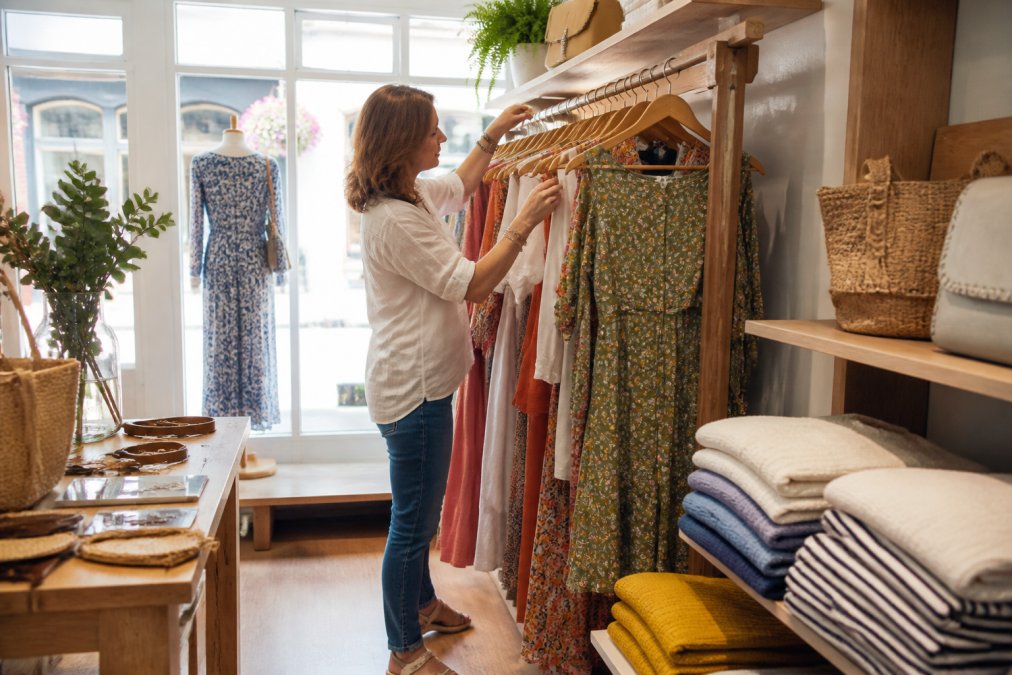
Ethical manufacturing tends to follow small-batch production.
The circularity angle most articles miss.
Spotting Greenwashing: How to Vet Small Brands Before You Buy
Greenwashing is when a brand markets itself as sustainable without the practices to back it up. Small brands aren't immune, and "eco-friendly" on a label means nothing on its own. Vet before you buy.
Ask these questions:
- Can the brand name its suppliers or makers?
- Does it explain its materials, or just use vague green language?
- Is the sustainability claim specific, or a slogan?
- Does the price make sense for ethical production?
Frequently Asked Questions
What are the main benefits of shopping at independent boutiques?
Independent boutiques offer curated collections, personal styling advice and garments made in smaller batches with better quality control. You get pieces that fit properly, last longer and reflect your personal style rather than passing trends. Many boutiques also offer delivery across the country, so you can shop from home without losing the personal touch.
How does fast fashion impact local businesses?
Fast fashion retailers use economies of scale to undercut local shops on price, which squeezes margins for independent boutiques. When you buy from a small boutique instead, more of that money stays in the local economy and supports jobs, craftsmanship and ethical manufacturing. Mass production often relies on disposable clothing made in factories with weaker labor rights protections.
What is the difference between slow fashion and fast fashion?
Slow fashion focuses on timeless design, garment durability and small-batch production, while fast fashion prioritises speed, low prices and constant new drops. Slow fashion brands use quality materials and ethical sourcing, which means your clothes last longer and have a lower environmental footprint. Fast fashion relies on trend cycles and disposable clothing, which leads to textile waste and poor value per wear over time.
How can I build a capsule wardrobe using boutique pieces?
Start with five to seven versatile items: a well-cut dress, tailored trousers, a quality knit, a structured jacket and two pairs of shoes that work for multiple occasions. Choose neutral colours that mix easily, then add one or two statement pieces from an independent boutique. Focus on material quality and fit rather than quantity. A capsule wardrobe built this way gives you more outfit combinations with fewer garments and better value per wear.